Becoming Japanese for a Day: My Tokyo Kimono Experience

The Threshold
There's a red gate in Tokyo that changed how I see clothes.
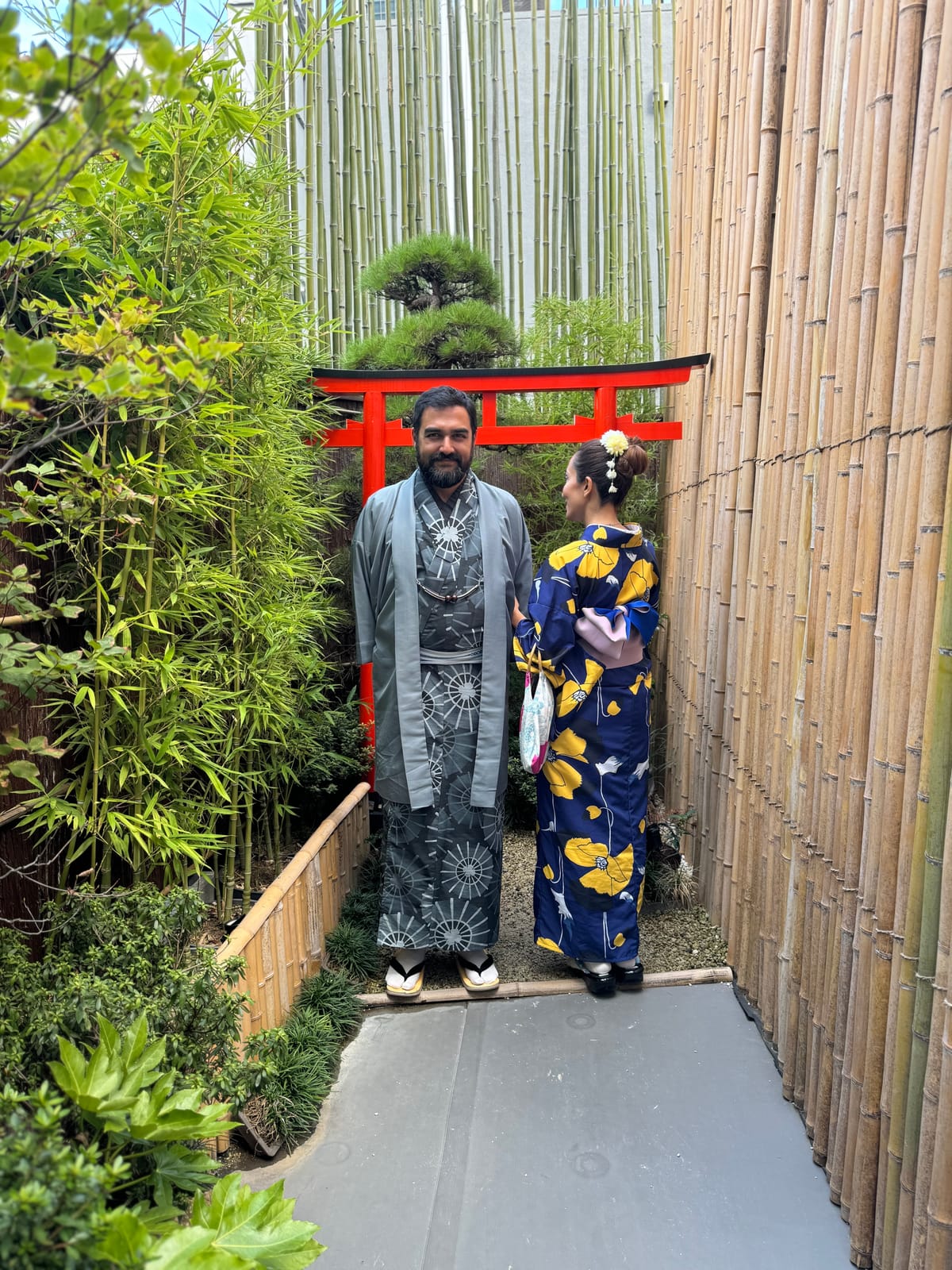
Not a metaphorical gate. An actual one—a torii, vermillion and weathered, standing in a bamboo garden where I stood wrapped in fabric that took 400 years to perfect.
The Japanese call the color of these gates shu. The rest of us call it red. But shu isn't just a color. It's protection. It's vitality. It's the boundary between the world you came from and something else entirely.
I walked through one wearing a stranger's history on my shoulders.
What You're Actually Wearing
Here's what nobody tells you about putting on a kimono:
It takes 12 separate pieces.
There's the hadajuban (an undergarment to absorb sweat), the nagajuban (a longer under-robe), the kimono itself, the obi (that impossibly wide belt), obi-ita (a stiffening board), koshi-himo (waist cords), date-jime (another belt under the obi), tabi (split-toe socks), and zori (sandals). And that's the simplified version.
The staff dressed me in layers I couldn't name while I stood there like a mannequin learning what it means to be wrapped in intention.
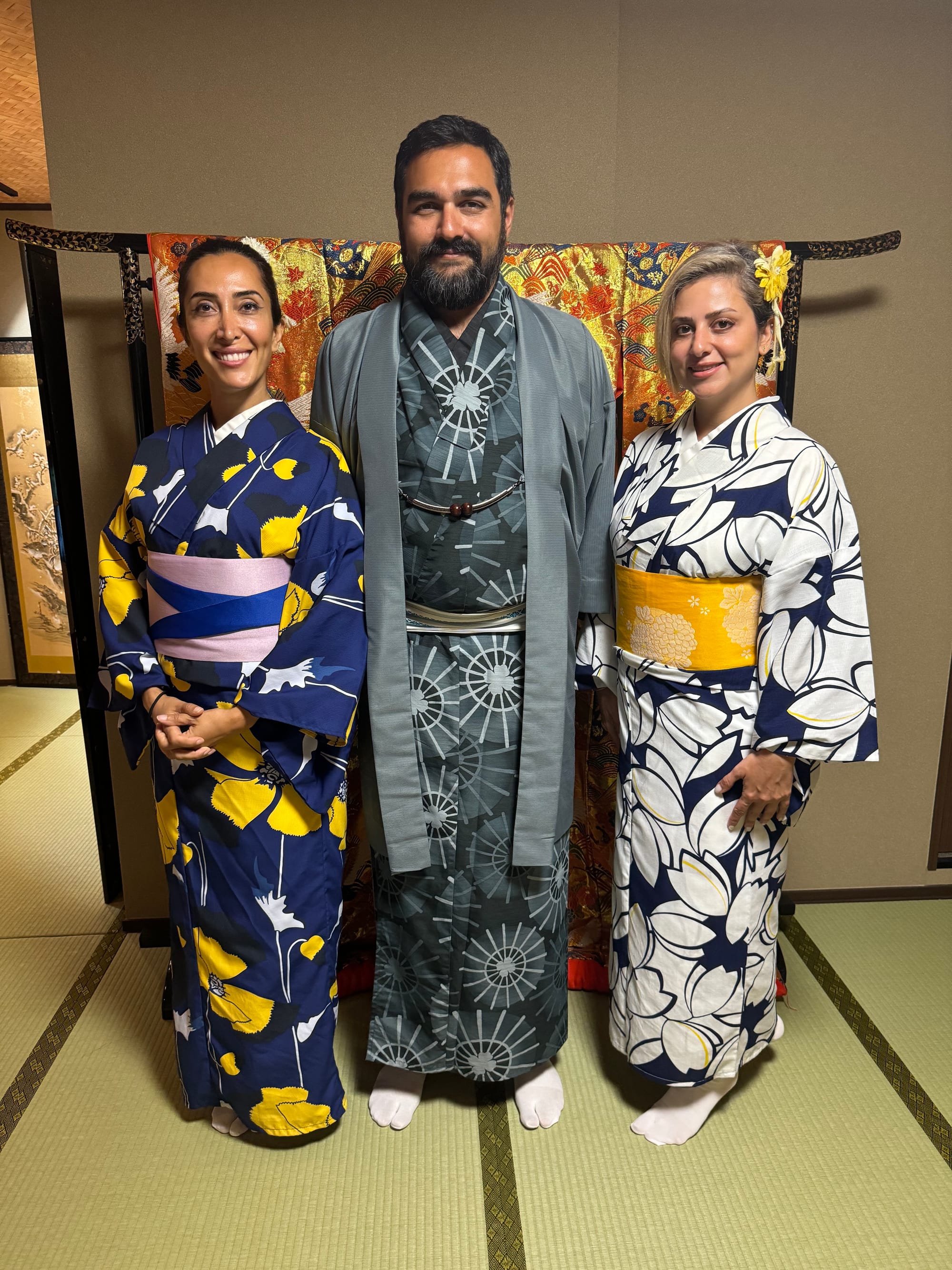
My outfit was a haori—a hip-length jacket—worn over a patterned kimono. Grey, with wagon-wheel motifs called waguruma. The haori dates back to the Sengoku period (1467-1615), when samurai wore them over armor in winter campaigns. By the Edo period, wealthy merchants began wearing haori with deliberately plain exteriors but lavishly decorated linings—a quiet rebellion against laws that restricted their clothing based on social class.
They could afford silk. They just couldn't show it.
Historical fact: The haori I wore would have been illegal for a common citizen to wear during the Tokugawa shogunate. Only samurai and nobility had the right to this garment. Later, geisha in Tokyo's Fukagawa district broke this tradition around 1800, wearing haori as a fashion statement—and started a trend that took 130 years to fully catch on with women.
The Weight of Silk
The women with me wore something heavier.
Traditional furisode-style kimonos with patterns that seemed to move even when they stood still—yellow flowers against indigo, white magnolias tumbling across navy blue. The obi alone—that wide decorative belt—can weigh several pounds when made of proper silk brocade. Some formal obi are 4 meters long.
What strikes you is the posture it creates. You don't slouch in a kimono. You can't. The structure holds you upright, transforms your walk into something more deliberate. There's a reason the Japanese word kikonashi—meaning the way one wears clothes—is considered an art form.
The price of tradition: An authentic silk kimono with custom dyeing (called yuzen, a technique from the Edo period involving hand-painted resist dyeing) can cost anywhere from $10,000 to over $100,000. What we wore were rentals—beautiful, but democratized versions of something that was once reserved for weddings, tea ceremonies, and the aristocracy.
A Garden That Isn't a Garden
The photo location was a bamboo garden in Tokyo—compressed, curated, perfect.
It had everything: moso bamboo arranged in a half-fence pattern, a sculpted pine (probably decades old), stone paths, and that red torii marking the entrance to a space that doesn't technically exist.
Here's what I mean: Japanese garden design is based on shakkei—"borrowed scenery." The idea that a garden should frame views beyond its boundaries, incorporating distant mountains or forests as part of its composition. But in urban Tokyo, there are no distant mountains. So these rental studios create contained worlds—gardens that exist entirely for the photograph, for the memory, for the three hours you spend pretending you're somewhere that time forgot.
The torii in this garden served no religious function. It was symbol stripped of context, made beautiful, made consumable.
And I don't know how to feel about that.
Why We Do This
More than 3 million tourists rent kimonos in Kyoto alone each year. Tokyo's numbers are harder to pin down, but the industry has exploded—driven partly by Instagram, partly by a genuine desire to touch something older than ourselves.
The Japanese have a word: furugi—old clothes. But more specifically, they have a phrase: mottainai—roughly, "what a waste." It captures the sadness of throwing away something that still has value. Kimono rental shops are, in a way, fighting mottainai. They're keeping these garments in circulation, on bodies, in photographs, in some version of living use.
Is it authentic? Probably not.
Is it appropriation? The staff seemed genuinely delighted to dress us. They adjusted my collar three times to get it right. They taught me how to hold my hands (together, in front, fingers hidden). They told me I looked kakkoi—cool.
What I think is this: every tradition was once an innovation. The haori was once controversial. The red torii was borrowed from Buddhism, which borrowed it from Indian torana gates. Culture is a river. You can step into it or watch from the shore.
The Photo
The three of us stood there—me in grey, them in explosions of color—inside a room with tatami mats and gold-threaded screens.
For a moment, we weren't tourists. We weren't playing dress-up. We were people standing in clothes that other people made with their hands, using techniques passed down through generations, wearing patterns that meant something to someone, somewhere, sometime.
Then we took our phones out and snapped the shot.
What Stays
I kept the tabi socks. Split-toed, white cotton, designed for a sandal I'll never wear again.
They sit in my drawer now, next to regular socks. Every few months I see them and remember:
The weight of the obi.
The sound of zori on stone.
The way the bamboo smelled.
The red gate marking passage into somewhere I couldn't stay.
Torii translates literally as "bird perch." According to Japanese mythology, the first torii was built to lure the sun goddess Amaterasu out of a cave where she'd been hiding—they placed roosters on a wooden perch, hoping their crowing would draw her curiosity.
It worked. She came out. The world had light again.
Some gates are meant to be walked through. Others are meant to remind you that the crossing was possible.
Tokyo, September 2024
Quick Facts
- Kimono rental cost: ¥3,000-10,000 (~$20-70 USD) for basic packages; premium experiences with photography can exceed ¥50,000
- Dressing time: 20-45 minutes depending on complexity
- Haori history: Originally samurai and nobility-only garment from 1500s; women began wearing them around 1800
- Torii gates in Japan: Approximately 90,000+ across Shinto shrines nationwide
- Torii color meaning: Red (vermillion) represents vitality, protection from evil spirits, and the sun's life-giving energy